
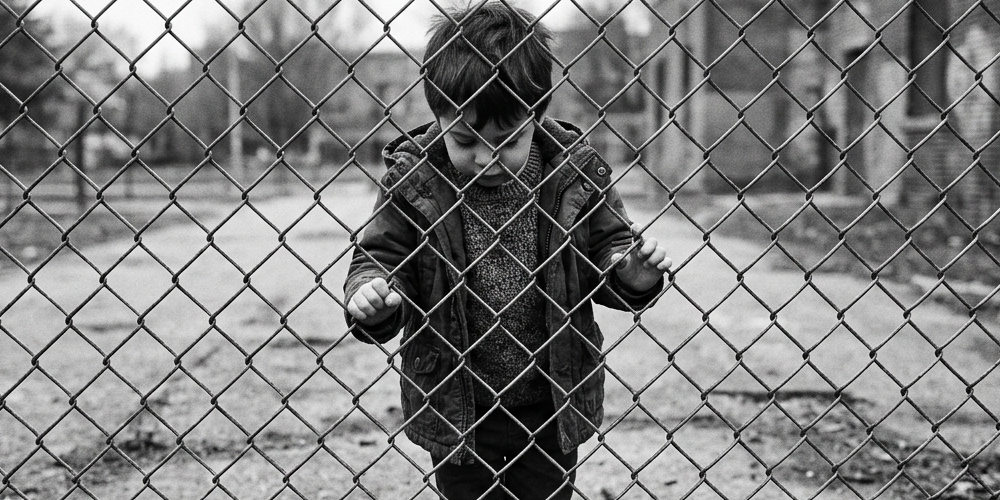
The promise was simple, repeated so often it became background noise. Be obedient, be pious, follow the rules, and you’ll be rewarded. Maybe not on earth, because earthly happiness (which was perhaps not even real or just a delusion) was trivial compared to eternal salvation, but certainly in the afterlife. Heaven for the good, hell for the bad. And if bad things happened to you anyway? Well, you must have done something to deserve it. It all balanced out. It had to balance. That was the foundation the whole system was built on.
I was the kid who actually tested it. Did everything I was supposed to do. Memorized the prayers my mother drilled into my head from birth and recited them every night without fail. Went to church weekly like clockwork until the age of twelve, attended Sunday school, followed by my first communion. Wholly immersed in the Catholic infrastructure designed to mold children into obedient believers. Worried constantly about doing bad things, sinning, disappointing God and my mother, which in my child brain were basically the same entity with equal capacity for punishment.
Other kids noticed. They didn’t seem to worry like I did even though many if not all were from religious families as well. They broke rules and were okay with it. Shrugged it off. Sometimes they made fun of me for caring so much, called me a fag and/or pussy for being so worried about everything all the time. But I kept following the script because that’s what I’d been taught to do, and the adults who wrote that script promised it would lead somewhere good. Also, I was terrified of their promised physical wrath here on earth if I didn’t do what they said.
Even so, no matter how well-behaved, I was going to burn in hell anyway.
Didn’t matter what I did, how disgustingly obedient or pious I was, my mother informed me on a regular basis that I was an evil child destined for eternal torture. I was possessed by demons, apparently. This wasn’t occasional criticism or correction but the running assessment of a child who was doing everything he’d been told to do. I prayed daily, attended Mass, and absorbed the guilt and fear and idea of sin and redemption like a good Catholic boy should. And I was still told I was damned.
The contradiction should have been obvious, but when you’re a child operating inside such a convoluted system, you can’t really see it. You just see your own failures. I must not be praying hard enough or must be doing something wrong that I don’t even recognize as wrong. The adults know things that I don’t know. God sees things I can’t see so the problem must be me.
But then there was the other half of the equation. The punishment for being bad wasn’t just eternal and abstract. It was immediate and physical.
The belt.
I still remember being whipped on numerous occasions, then scurrying away to some corner of the apartment, lying on my side because sitting was too painful, and crying until I couldn’t cry anymore. This was the earthly enforcement of divine law. You’re “bad” and you get punished. Although I almost never understood what “bad” things I actually did and was simply told that I knew what I’d done and to stop pretending like I didn’t. The theological and the physical were linked, two parts of the same control mechanism.
But here’s where it all started breaking down for me. If I was already being punished and already damned no matter what I did, what exactly was I following the rules for?
The promise said be good and avoid punishment. But I was being good and being punished anyway. The threat said be bad and you’ll suffer. But I was already suffering. The whole belief system depended on a clear correlation between behavior and outcome, and that correlation didn’t exist. I was living proof that the equation was bullshit.
The realization didn’t come all at once, however. It was gradual, spread out over years as I got older and started noticing things. That life seemed pretty random and bad things happened to people regardless of whether they deserved it or not. The promised order didn’t actually exist in observable reality. I noticed that “sinful” people often seemed happy when I almost never was, which didn’t make sense if the whole point of sin was that it led to misery.
But the real discovery came when I got physically bigger than everyone else in my family. Suddenly the way they treated me changed. The people who’d spent years telling me about God’s judgment and eternal consequences started being more careful around me, probably worried about what I might do to them if they kept treating me the way they had when I was smaller than everybody. The whole power dynamic shifted, and it had nothing to do with God or morality. It was just fear. Physical fear of physical consequences.
That’s when I understood what the religious structure actually was: a control mechanism for people who were physically or socially powerless. It worked on children because they can’t fight back and on people who’d been conditioned and browbeaten, as well as beaten, into believing that authority figures spoke for God. But it fell apart the moment the power dynamic shifted, which meant it was never about God at all. It was about power. The theology was the justification.
Once I saw that, walking away was easy. Not emotionally simple, because nothing about separating from your family and rejecting the worldview you were raised in is emotionally simple. But logically easy and intellectually obvious. You stop using the equation that doesn’t work. If the system punishes you regardless of your obedience, then you stop being obedient. There’s no downside to leaving if the threatened consequences are already happening.
So what actually occurred when I turned my back on religion and separated from my religious family? Nothing catastrophic. No lightning bolts or cosmic retribution. People who’d spent years lecturing me about God’s will accepted my apostasy with a shrug, a dismissive “I’ll pray for you” and simply moved on with their lives. The threatened punishments didn’t materialize because they were never real. They were just stories told to maintain control and only worked if you believed them.
Things didn’t automatically get better when I left though. I’m not going to pretend there was some profound healing breakthrough. Life was just different. Fear wasn’t all-consuming anymore, which provided room to breathe and think. I wasn’t performing constant self-surveillance, monitoring every thought and action for potential sin. No longer trying to meet an impossible standard set by people who didn’t even believe in it themselves, as evidenced by how quickly they abandoned their principles when they thought I might actually fight back.
What I’m describing isn’t a crisis of faith or a philosophical journey. It was a basic analytical assessment. I’d put in all the work, followed all the rules, and gotten none of the promised rewards while still receiving all the threatened punishments. That’s a bad deal. You don’t need to have a spiritual awakening to recognize a bad deal. You just need to look at the results.
The religious dogma I was raised to blindly follow depended on several assumptions: there was a clear correlation between moral behavior and life outcomes, authority figures who spoke about God were trustworthy, the promised rewards and threatened punishments were real and the people enforcing the system actually believed in it. Every single one of those assumptions turned out to be false.
I was supposed to be the success story. The obedient pious boy who proved the system worked. Instead, I became the evidence that it didn’t. I followed the script perfectly and ended up miserable anyway, which meant either God was capricious and morality was meaningless, or the people who designed the system were lying about how it worked. Turns out it was the latter.
This is what people don’t or refuse to realize about religious indoctrination of children. The problem isn’t just that the theology might be wrong or the moral structure flawed but that the whole system is often built on a foundation of dishonesty about cause and effect. Be good and good things will happen. Be bad and bad things will happen. That’s not how reality works, and any child who actually tests the hypothesis by being genuinely obedient will eventually notice the discrepancy.
I noticed. And once you see that the scale doesn’t balance and the promised correlation doesn’t exist, that the people preaching the system don’t actually believe in it themselves, walking away stops being a rebellion and starts being a rational response to failed predictions.
The good Catholic boy went to hell anyway according to his devout mother, despite doing everything right. So he figured he might as well stop pretending the rules mattered and start making his own rational judgments about how to live. Turns out that was the only equation that ever truly worked in the first place.