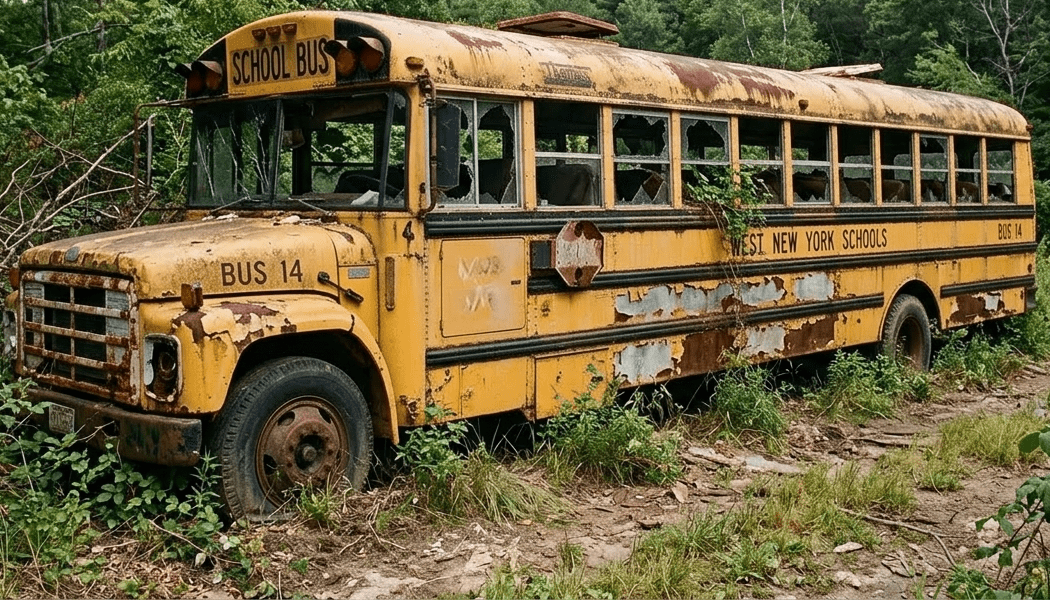
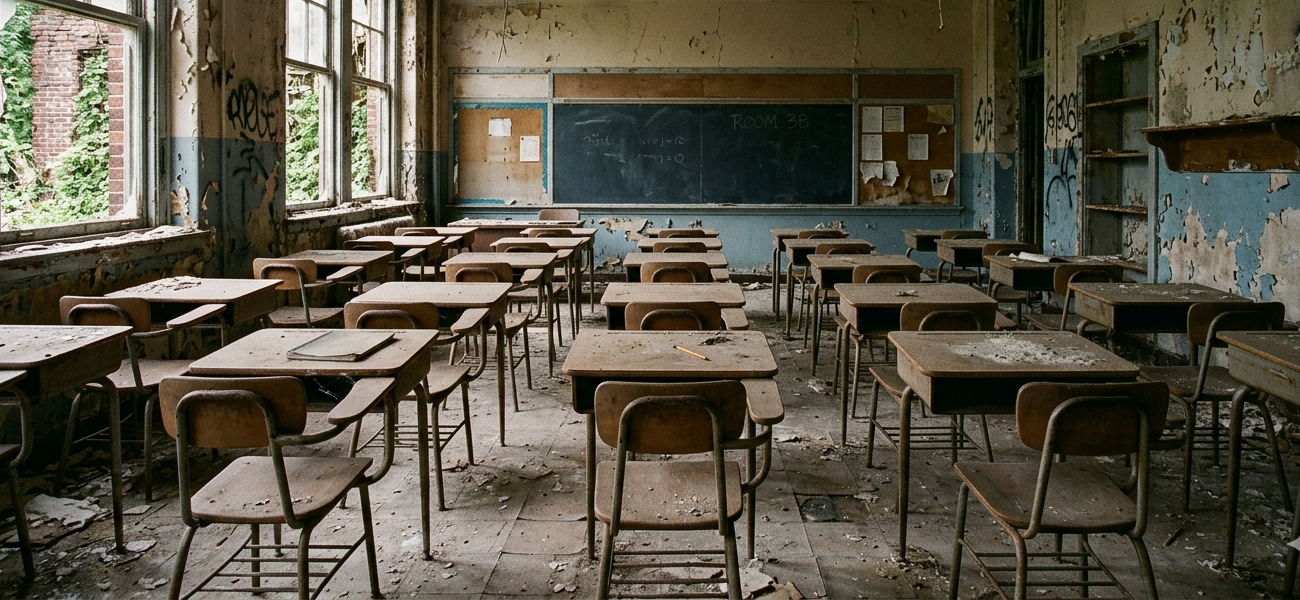
There’s a specific kind of panic that can only exist when you’re a child going to grammar school and when you’re six years old sitting in a first-grade class with a bladder screaming for relief while a woman who terrorized her students like a drill sergeant presides over the room, that panic becomes your entire universe.
She was the type of teacher who made kids scared to breathe too loudly. Don’t remember her name anymore, but I recall the fear she evoked. You’d get detention for being out of line … literally.
Be lined up even slightly out of formation when she was about to walk us somewhere like the library, gym, lunchroom or wherever, and you’d have thirty extra minutes added to your school day. You could get yelled at for spending more than five seconds at the pencil sharpener and she had no problem calling any child stupid for any reason. Just another tool in her arsenal. One she used on me many times. And you absolutely did not talk back. Ever.
This sort of behavior wasn’t unique to her, though, as similar things could be said of basically every adult I encountered growing up. She was just the one whose presence I had to endure for hours every weekday among other kids when I was six.
Every student in that class walked on eggshells. So, when my bladder started sending urgent signals that afternoon, I probably sat there longer than I should have while working up the nerve to even make the request.
Don’t remember what we were supposed to be learning that day or the excuse she gave, if any, for refusing me. But the flat denial is still vivid. The finality of it. And the absolute certainty I couldn’t push back or ask again.
When you’re six years old and already scared of pretty much all authority figures, you don’t yet have the ability to understand adults can be wrong. You just know the terrifying person said no. And so I sat there, squirming, concentrating every ounce of willpower on keeping it together until the bell rang.
When the clock struck 2:45 PM, the end-of-day routine began.
Same choreographed sequence every afternoon:
clean up your desk .. put your materials away .. get your coat and bookbag from the closet .. then line up at the door. Each task felt like an eternity.
I just kept repeating the same mantra in my head:
‘Hold it. You can hold it. This is almost over. You’re only a few minutes from being back home.’
Made it through tidying my desk with my legs pressed together. Coat closet came next. Zipped up my jacket. The lineup was after that. Everyone waiting for the teacher to dismiss us. Then the hallway, weaving through the crowd of kids heading for the buses. Onto the bus and into a seat.
And then, maybe just two or three minutes into what should have been an easy if seemingly bumpier than usual five-minute ride home, my body made the decision my teacher didn’t allow me to make.
The warmth and wetness came first. Then the smell. Then the horrifying realization of what had just happened.
I was so close.
If I’d been able to hold on for a couple more minutes, I would’ve made it home. Instead, I looked down at my pants darkening with piss and felt my face get hot.
The tears came immediately.
Within seconds all my classmates on the bus knew what happened. They fled noisily to the back, grossed out, and the name-calling began.
Now here’s where something shifted inside me. Maybe it was anger at the injustice of it all or having nothing left to lose, but I unleashed a torrent of cursing at my fellow first graders. Don’t remember exactly what words but there was definite blistering fury behind them. And somehow, impossibly, I got them to shut up. They stayed at the back of the bus, but the mockery stopped.
Didn’t wait for anything when we reached my block. Ran right off the bus, past the oblivious bus driver, moving as fast as possible toward my apartment building with the objective of minimizing the trail I was leaving behind and not getting seen by anyone who hadn’t been on that bus. Pants dripping, face wet with tears and carrying the kind of shame that burns itself into your brain for decades.
What happened after I got home is mostly a blur, like so many fragments of a childhood I’ve mostly forgotten, which is probably for the best since the stuff I do somewhat remember is still haunting and sensitive to touch. But I do remember my mother’s general response. Something along the lines of:
‘I can’t believe you did this. I can’t believe you allowed this to happen. You’re disgusting and now I have to clean up your mess.’
I stood there, still damp with piss, wondering if she was going to hit me, since that happened often enough I came to expect that kind of response for anything, and I do mean ANYTHING, I ever said or did. But I can’t say with certainty whether that happened or not.
Somehow, this was all my fault and possibly even intentional or premeditated. Everything was always my fault and probably deliberate as far as she was concerned, so why would this be any different? My brother, five years older and an outright bully until I physically outgrew him, thought it was absolutely hilarious. The kind of ammunition for targeted degradation that would get brought up for years after.
The teacher was a monster. My mother blamed me for my own humiliation. My brother thought it was comedy gold. But somewhere in that experience, six-year-old me began to fully realize what my subconscious had unwillingly but only briefly acknowledged before in bits and pieces. The world was never going to come close to being fair, the people in charge weren’t necessarily there to protect or help me, and oftentimes the only person I’d be able to count on to stand up for me was me.
Valuable life lessons even if I was sitting in a puddle of my own piss when I learned them.