
There’s an assumption you don’t even know you’re making until something forces you to examine it. For me, that assumption was simple and seemingly unassailable. Being human meant being part of some religion. That’s how the world worked. Everyone was Catholic or Jewish or Muslim or Hindu or Buddhist or something. You didn’t choose whether to participate. You chose which one or most likely it was chosen for you.
I’d already walked away from Catholicism by the age of thirteen. The hypocrisy had made that easy. Watching people who treated religion as a performance for Sunday mornings while demonstrating zero actual moral character the rest of the week had stripped away any illusion that the theology mattered to the people enforcing it. The threats of hell and promises of heaven had lost their power once I understood they were tools for control, deployed by people who didn’t even believe in them enough to live by their own stated principles.
But even after rejecting that specific doctrine I’d been raised in, I still operated under a baseline assumption. I wasn’t Catholic anymore or even Christian, but I needed to be something,.. right? The question wasn’t whether to have a religion, it was which one to choose. That seemed like basic reality, like accepting that you need to eat or sleep or breathe. Religion was part of being human. Opting out entirely wasn’t even a concept I’d considered or thought was even possible.
Then I found a book. I have no memory of where it came from. Maybe one of those school book fairs where you could buy paperbacks for a dollar or two. Maybe a library or it was sitting somewhere and I picked it up. What I do remember is that it was a basic overview of world religions. The kind of thing that gives you the CliffsNotes version of Judaism, Hinduism, Buddhism, Islam, and a few others. Not deep theological analysis, just the fundamental beliefs and practices laid out in accessible summaries.
I started reading with what I thought was an open mind. I was going to find the right one. Whichever religious framework made the most sense, that’s what I’d become. One of them had to be more logically coherent than Catholicism. More intellectually honest and less obviously built on hypocrisy and control mechanisms. I was religion shopping, sort of, comparing options like you’d compare different brands of the same product.
But it didn’t take long for me to realize I was looking at the same product in different packaging.
The details may have varied. Different origin stories. Different ritual practices and names for the divine figures but the fundamental structure was the same. Supernatural claims that required belief without evidence. Moral belief systems that depended on reward and punishment in some afterlife that couldn’t be verified. Authority figures who claimed to speak for entities no one had ever actually seen. Rituals designed to demonstrate obedience to doctrines that made no logical sense. And fear was always somewhere in the foundation. I couldn’t find a version without it.
Vishnu, Buddha, Yahweh and Jesus (not to mention Zeus) weren’t meaningfully different from each other, at least not to me. They were all characters in mythology. The fact that billions of people took some of these myths seriously while recognizing others as obvious fiction didn’t make the “serious” ones any more real. It just meant some stories had better marketing and longer institutional support.
Christianity wasn’t uniquely flawed. It was typically flawed. Every religion I looked at was doing the same thing. Making supernatural claims while demanding faith when evidence was absent. Fear and hope used to control behavior. Supposedly deep rituals which were really only performances of submission to arbitrary authority.
I put the book away without ever truly finishing it. I didn’t need to. There was nothing there for me. No “right” religion waiting to be discovered. Just variations on the same theme of superstition and control that I’d already rejected when I walked away from Catholicism.
And then, like getting bopped on the head by a falling apple in some story about Isaac Newton, a thought occurred to me that should have been obvious but somehow hadn’t been. I didn’t actually have to choose any of this.
It was entirely optional.
Religion wasn’t a mandatory component of being human. It was simply something most humans did, which wasn’t the same thing at all. I didn’t need to replace Catholicism with something else. I could just… not participate. Could live my life without subscribing to any supernatural belief system. Without joining any religious community or practicing any rituals designed to appease entities that have never existed.
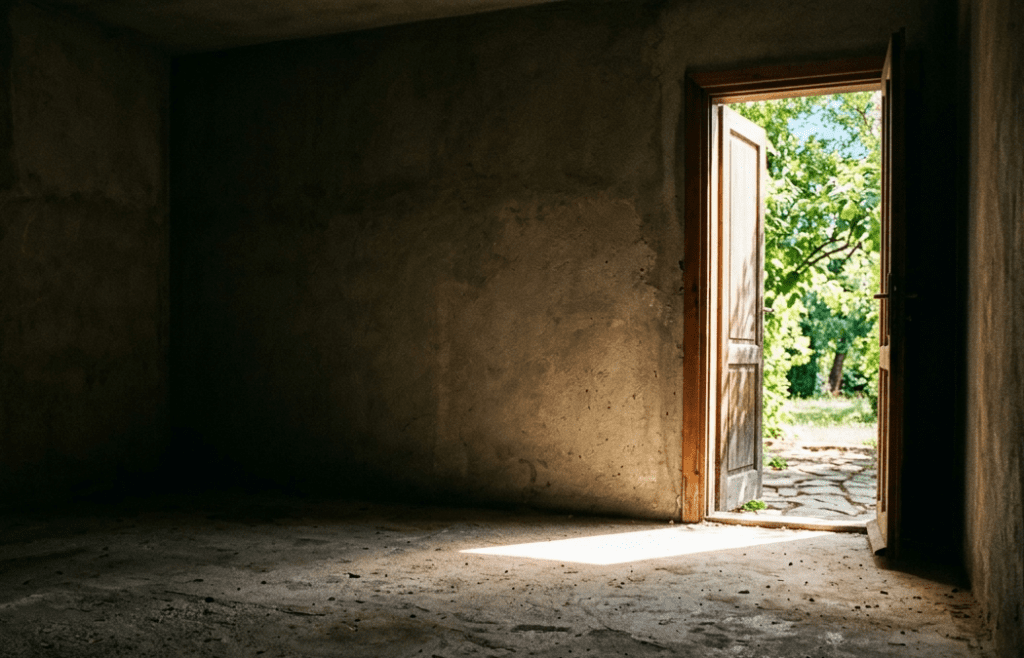
It felt like suddenly becoming aware that you could exit a room you’d only now realized had a door and wondering why you’d never noticed it before. Or discovering that a rule everyone followed wasn’t actually a rule at all but a widely shared assumption that nobody had bothered to question.
I’d had my own eureka moment like Archimedes in his bath, except I didn’t start running around naked through the streets of my neighborhood. I just sat there thinking.
Why didn’t I see this before?
The answer was embarrassingly simple. I hadn’t seen it because I’d never thought to look. The assumption that religion was mandatory had been so fundamental, so baked into how I understood the world, that questioning it hadn’t even occurred to me. You questioned which religion, not whether religion.
I don’t think I even knew what an atheist was at that point. The words didn’t matter. I’d arrived at the position through basic logic rather than learning it from someone else’s ideas or deconstruction story. Religion required believing things I didn’t believe and behaviors which made no sense outside that belief structure. Therefore, I wouldn’t do it. The end.
Shaking off the remaining residue of religiosity left over by my Catholic upbringing was surprisingly easy once I understood participation in any of this was optional. The guilt and ritualized shame around normal human conduct lost its power immediately. The fear of hell disappeared. That machinery only worked if you accepted its premises. Once you understood that the premises were just stories people told to control other people then the machinery couldn’t touch you.
What I felt more than anything was anger and frustration. Not at God, since he/she/it was obviously make believe but at all the wasted time and energy. I’d spent years obsessing over nonsense, letting it shape how I lived and saw myself. Treating these fictional narratives as if they described reality. All because the adults around me insisted it was mandatory and I’d been raised to never question and just accept that basic premise.
I was almost fourteen years old and already wasted over a decade on superstition. Time spent worrying about sins and divine punishment and whether I was praying correctly. Energy devoted to engaging in rituals I didn’t understand in service to entities I eventually learned weren’t real. Guilt and shame over thoughts and actions that were completely normal because some ancient text said they were wrong.
All of it completely unnecessary. All of it optional. And nobody had ever mentioned that nor did it ever occur to me.
By thirteen, I’d already distanced myself from my family both emotionally and physically. I had no real friends and no one to talk to about anything substantive. So there was no one to tell about this realization, no one to process it with or argue against. The cognitive shift happened in isolation, which meant it happened clearly, without social pressure or emotional complications.
I just stopped. Stopped pretending and participating. Stopped treating religious claims as if they deserved serious consideration. The belief structure that had organized my entire childhood collapsed in the time it took to ask a single question.
Why does this have to be mandatory?
And the answer was: it doesn’t.
No dramatic crisis of faith. No period of painful doubt or soul-searching. Just the sudden clarity that comes from recognizing an assumption you’d never examined before was completely unfounded. Religion was something humans created in a desperate attempt to explain what they didn’t understand and try to control what they couldn’t predict. I understood that now. And understanding it meant not having to be part of any of it.
The world continued exactly as it had before. I just moved through it without the burden of supernatural belief. Without the performance of piety or the guilt and fear that religious dogmas depend on to maintain their grip. I’d discovered the exit. And once you know the door exists, you can’t unknow it.
Some people spend years or decades wrestling with doubt before they finally walk away from religion. They describe it as painful. As a loss or a kind of death of their former self. I experienced none of that. I experienced relief and clarity and anger at wasted time.
But maybe that’s because I’d never really believed in the first place. Because I’d seen through the hypocrisy early enough that the theology never took deep root. Perhaps that’s how my brain processes information. I see the logical inconsistency and reject the shaky structure. I move on.
Or maybe it’s because I was thirteen and already isolated and had nothing to lose by opting out of a system that had never actually offered me anything worth having.
Either way, the door stayed open once I found it. And decades later, I’ve never encountered a convincing reason to walk back through it. The world makes much more sense when it dawns on you that humans invented gods rather than the other way around and you recognize that morality doesn’t require supernatural enforcement. You understand that meaning is something you create rather than discovered in ancient texts.
Religion is optional. That’s the revelation. Everything else is details.