
Part 1 – The Uncle-In-Law’s Relative’s Place
It didn’t happen exactly on Christmas, but it was definitely around the holidays on a Saturday night, and I was ten years old.
I’d been dragged to some family’s home for a holiday dinner. They were friends or relatives of my uncle-in-law or something, one of those strange extended-family relationship things you’d find on some chart that nobody really understands. The house was in a neighborhood I’d never been to before, on the kind of street that looks exactly like every other residential street which you realize you can’t remember a single distinguishing feature of when trying to give someone directions to.
The dinner itself was the definition of unremarkable. Adults talked about adult things. Food appeared and disappeared as I sat there shifting in my chair, bored out of my mind, counting down the minutes until we could leave. There was something on TV I wanted to watch while in my pajamas at home.
By the time people started making those pre-departure noises after their bellies had been filled and the post-dinner small talk and pleasantries had run their course, the “well, we should probably get going” remarks that somehow take another forty-five minutes to actually result in anyone leaving, it was approaching 11 PM. I’d moved past restless into actively complaining about how long this was taking. We obviously weren’t staying the night. We lived maybe fifteen minutes away by car. This should have been simple.
But apparently the person who’d driven us there was suddenly unavailable to drive us back. I still don’t know why. Maybe they’d left early. Maybe they were too drunk or something. Whatever the reason, we needed a ride, and someone at the gathering volunteered.
“I can take them.” he said, cheerfully.
Then, because apparently this needed to be stated:
“I’ve had a few, but I’ll drive slow and careful.”
He looked like he was in his twenties, maybe early thirties. He wasn’t staggering or slurring his words. On the surface he seemed perfectly functional. Calm and steady, and perhaps a little too confident about his ability to operate a vehicle after having imbibed a few adult beverages. This was the 1980s, and while things were a bit different than today, drunk driving was still treated as something irresponsible people did on purpose, not something that perfectly reasonable people did after having had “a few” drinks at a family gathering. However, the adults around me accepted his offer with appreciation and without any visible concern, like this was a completely normal solution to a minor logistical problem.
I was the only one who seemed even slightly worried, and I was ten. I didn’t have the language to articulate why this felt wrong, just a vague sense of unease sitting in my stomach next to the dinner I’d barely touched. But what was I going to do? Make a scene? Insist we call a cab and deal with my mother’s irritation at the extra expense and hassle? I was a kid. And kids don’t get to overrule adult decisions, even stupid ones.
So, we ambled into the car.
It was a station wagon, one of those boat-sized vehicles from an era when cars were built like tanks and safety features consisted mainly of the vehicle’s sheer mass. My brother and I climbed into the back seat, the long bench seat that ran the width of the car behind the driver. My mother got in beside us. I ended up sandwiched in the middle, with my brother on one side and my mother on the other.
Before getting in, I’d briefly considered lying down in the very back, in that cargo area behind the rear seat. I was tired, it was late, and stretching out for the ride home seemed like the best way to salvage something from this tedious evening. Then I actually looked at the back area and saw dust and grime coating every surface. It looked like no one had cleaned back there in months, maybe years. I decided against it.
True to his word, the driver started off very slowly. Almost comically slowly. Overcautious to the point where I started doing the math in my head: at this pace, a fifteen-minute drive was going to take an hour. But I guess that was the deal. He’d had “a few,” so he was going to compensate by driving like someone’s grandmother on her way to church.
The streets were completely empty. This was late on a Saturday night in a quiet residential area, and there wasn’t another car in sight. No traffic and zero pedestrians. Just cold empty roads and our station wagon creeping through the darkness like we were in a funeral procession. Under different circumstances it might have been peaceful. Instead, it just felt like the night was dragging on even longer than it needed to.
We approached a two-way intersection. The driver began making a very slow turn onto the lane that stretched toward the way back to our home. The turn was taking forever. The station wagon moved with all the urgency of a snail.
I was sitting in what was probably the exact center of the automobile. The perfect place to be considering what was about to happen. I turned my head to the left and saw headlights in the distance. They had to be at least fifty yards away, most likely more. I remember very clearly having this thought, almost like a joke I was telling myself: if this guy doesn’t hurry up and finish turning this boat of a car, those headlights are going to slam right into us.
But that was absurd. Impossible. Even with him taking his sweet time with the turn, there were literally no other cars anywhere near us. We had the entire intersection to ourselves. The other driver had more than enough time to slow down. Hell, to come to a complete stop if necessary. There was no scenario where anything bad could actually happen. The universe would have to actively conspire against us for those headlights to become a problem.
I looked away. Probably rolled my eyes because of how slowly we were moving and let my attention drift to something else.
Then, just a few seconds later, something made me look left again.
The headlights were right there.
Before I could even form the thought “oh shit,” the impact happened.
The station wagon was hit toward its rear, on the driver’s side. In the space of a single second, the world went from slow and quiet to violent and chaotic. There was noise. The noise of metal crumpling and glass breaking and the sound of physics doing something cars aren’t designed to do, but it all happened so fast that the individual sounds blurred together into one massive, abrupt bang.
The car whipped around. Not like we’d been bumped or nudged off course, but like someone had grabbed the entire vehicle by the tail and spun it 180 degrees. We ended up facing the opposite direction from where we’d been headed, the nose of the station wagon now pointing back toward the intersection we’d just been trying to leave.
I felt the spinning. The whole world rotating around me in a way that didn’t make sense, that violated some fundamental rule about how cars are supposed to move through space. But I didn’t feel the impact so to speak. I was sandwiched between my brother and my mother, positioned in the exact center of the car, and somehow the crash itself didn’t touch me. No collision with the door. No violent jerking against the seat. Nothing. Just the spinning, and then suddenly everything stopped.
The whole thing from the moment those headlights appeared right there to the moment the station wagon came to rest facing backward probably lasted three to five seconds.
I don’t remember anyone screaming. I don’t remember panic or crying. It happened too fast for that. One moment we were crawling through an empty intersection, and the next moment we weren’t. Now our brains were trying to catch up with what had just occurred.
After I got out of the car .. carefully, because even at ten I understood something was very wrong and needed to have my wits about me, I saw the rear of the station wagon for the first time since the impact.
It looked like it had been folded. The back of the car was just gone, crumpled and compressed into maybe half the size it used to be. That cargo area where I’d almost decided to lie down? If I’d been back there, I would have been crushed.
The dirt had saved me. Random chance and a minor preference for cleanliness over comfort had put me in the one spot in the vehicle where I was somehow left untouched.
====================
Part 2 – After The Impact: Silence
Not the peaceful kind of silence, but something heavier and stranger. The kind of quiet where every small sound becomes magnified because your brain is desperately searching for information about what just happened and whether it’s still happening. The world had been violent and loud for maybe three to five seconds, and then it just stopped, like someone had hit a pause button on reality.
It was dark inside the station wagon. Too dark to see much of anything. I sat there in the middle of the back seat, sandwiched between my brother and my mother, trying to assess whether I was hurt. I moved my arms slightly, shifted my legs. Everything seemed to work. No sharp pains or wetness that might be blood. Nothing obviously broken. Physically I felt fine, or at least I didn’t feel anything at all, which at that moment seemed like the same thing.
Emotionally I was somewhere else entirely. Everything felt muffled and distant, like I was watching the scene from behind thick glass. My body was there in the car, but my mind was having trouble catching up to what had just occurred.
The only sound I could make out was a rhythmic clicking noise. I think it was coming from whatever lights on the station wagon still worked, their circuits damaged and stuck in some loop between on and off.
Click .. Click .. Click ..
The sound felt both annoying and weirdly comforting, proof that something was still functioning even if the car itself was destroyed.
At least ten seconds passed without anyone saying anything. Maybe longer. One’s perception of time does strange things in moments like that. Finally, a voice broke through the silence:
“Is .. Is everyone okay? Is anyone hurt?”
I didn’t respond. I’m not sure if I couldn’t or just didn’t. Not even sure whose voice it was. The question seemed to come from very far away, like it was meant for someone else.
Eventually we all started moving. Carefully. Very carefully. Someone, my mother?, the driver?, told us to be careful getting out. I don’t remember the actual process of exiting the vehicle, but I remember the deliberateness of it, the sense that we needed to move slowly and check each step. Maybe doors on one side were crushed and we had to exit from the other side. Maybe we were worried about broken glass or unstable metal. I just remember being careful and being told to be careful.
When I stepped out into the frigid December air, it hit me immediately. We’d been cocooned in the car, and now we were standing on a dark residential street with the winter wind cutting through our clothes. There might have been a smell. Trees, maybe? The station wagon had ended up close to some trees but I don’t have a clear memory of that. Just the cold and the darkness and the strange quiet of the neighborhood around us.
We stood there under the dim streetlights and looked each other over. Everyone was checking over everyone else and then running their hands over their own arms and legs and so forth, looking for blood or obvious injuries. I moved my whole body. First arms, then legs, then torso, then neck. Testing each part to see if anything hurt. Nothing did. No pain at all, which seemed impossible given what had just happened but was undeniably true.
There was no blood, at least not in any significant amount. I think the driver might have gotten a few cuts, minor ones from broken glass, but that was about it. We’d all been wearing winter coats and layers, and I remember thinking even then that the heavy clothing had probably helped protect us from the glass. Physics, dumb luck and padding had somehow combined to let us walk away from a crash that should have hurt us much worse than it did.
The driver was panicked. That much was clear even in the darkness. He was apologetic, kept asking if everyone was okay, and you could tell he knew he was in serious trouble. He’d promised to drive slowly and carefully. He’d done exactly what he said he would do. And it hadn’t mattered. Something had gone catastrophically wrong anyway, and now he was standing on a cold street looking at a destroyed station wagon and probably calculating what this was going to cost him in ways that had nothing to do with money.
I looked across the street at the other car.
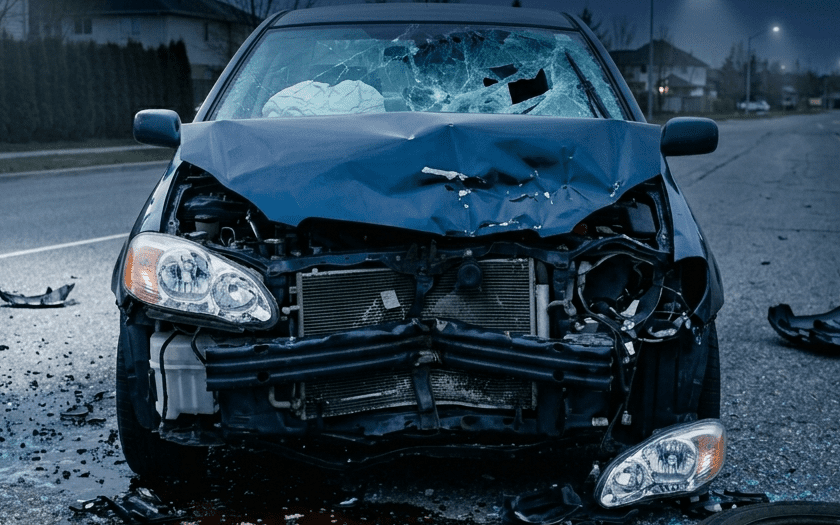
It was maybe a couple hundred feet away, though I’ve never been good at judging distances especially at night. The front end was completely smashed in, folded like an accordion. It was a much smaller car than the station wagon. A compact sedan or something similar perhaps. And unlike our vehicle, where everyone had climbed out and was standing around talking, there was nothing coming from that car. No movement or sounds. No signs of life that I could see or hear from where I stood.
I didn’t know what to think about that. Part of me assumed that if we were fine, maybe they were fine too. We’d all been in the same crash, after all. But I was also looking at how much more damaged their car was compared to ours and much smaller as well. How it had absorbed the impact in a way that compressed the entire front section into something that barely looked like a car anymore. And somewhere in my ten-year-old brain, I understood that the person/people in that car probably hadn’t been as lucky as we had.
We stood there in the cold, not saying much of anything. The adrenaline was probably still coursing through everyone’s systems, but the immediate crisis had passed and now we were in some surreal space waiting for whatever came next. My mother was probably, no, scratch that, she was DEFINITELY praying. That would have been her instinct in a situation like this or any situation really. Silent prayer, an internal conversation with a God I’d actually just recently begun to question the existence of but that she wholeheartedly believed in.
The driver eventually walked off to find help. This was the mid-1980s, so nobody had a phone on them. He had to find the nearest house that was still awake or business that was open or public pay phone or actually wake someone up, someone who would let him use their phone to call 911. He disappeared into the darkness, and we waited.
What struck me even then was how deserted everything was. We’d just been in a massive car crash. There had been a loud impact, the sound of metal crumpling and glass breaking. The noise of our station wagon spinning around on the asphalt. And yet no one came out of their houses. No porch lights flickered on. No curious neighbors appeared to see what had happened. The street stayed as dark and empty as it had been before the crash.
I remember wondering why there weren’t people around gawking. That’s what happened in movies and on TV. Car crashes drew crowds and people come running from seemingly everywhere to help or stare. But it was probably midnight by now on a Saturday in December in a residential neighborhood. Every house would have had their doors and windows shut tightly against the cold. Who knows what anyone heard, or if they heard anything whether they decided it wasn’t worth investigating, or if they were already in bed and just rolled over and went back to sleep figuring someone else would handle whatever was happening outside. A sentiment which was quite common from what I’d observed in my young life.
The wait felt longer than it probably was. Maybe ten minutes total from when the driver left to when we heard sirens in the distance. Ten minutes standing in the cold, not talking much. Just waiting and trying to process what had happened while also not really wanting to think about it at all.
The police arrived first, then an ambulance. Flashing lights cut through the darkness, red and blue strobing across the trees and houses and the wreckage of two cars. More adults and more authority figures. People whose job it was to take charge of the situation and figure out what to do next.
I tried to blend into the background. That was my instinct. Fade into the periphery and don’t draw attention, just wait for this to be over so I could go home. I was fine physically, everyone in the station wagon was basically fine, and there was nothing I could contribute to whatever was happening now. So I made myself small and quiet and tried to be invisible in the way kids can sometimes manage when adults are dealing with adult crises.
It worked. I was mostly ignored. Nobody asked me questions or checked on me specifically. I was just a kid standing in the background, uninjured, not crying, not causing any problems. The police and paramedics were focused on the adults in our group and on whatever was happening with the other car. I remember watching from a distance as they dealt with the other vehicle, but I couldn’t see much and nobody was explaining anything to me nor did I really want that. I didn’t see anyone being taken out on a stretcher, but I also wasn’t positioned to see everything that was happening. The whole scene had a disconnected quality, like I was watching something on TV with the sound turned down.
I just wanted it to be over. I wanted to go home and get out of the cold. Stop standing around on this dark street with flashing lights and serious adult conversations happening around me. The crash itself had been frightening but brief. The aftermath, however: the waiting, the authorities, the lingering uncertainty about what happened to the people in the other car, felt like it was dragging on forever.
Eventually we did go home, via taxi. The station wagon obviously wasn’t drivable anymore and the driver would be busy attempting to explain what happened to the police. I didn’t bother mentioning that I had suggested taking a taxi home when still at the uncle-in-law’s relative’s place.
In the days and weeks that followed, I picked up fragments of information about what came next. I overheard my mother talking on the phone with someone, probably her sister, about court and possible prison time for the driver. When I asked her what was going on she gave me the bare minimum. Something about a trial and legal happenings and then moved on without elaborating. That was typical for her. She wasn’t the type to explain things to me or help me process experiences. Didn’t think that was important or worth her time. Information came in pieces that I had to assemble myself, like a puzzle where most of the pieces were missing.
I gathered that the driver had gotten in serious trouble for driving while intoxicated. He might have eventually been sentenced to prison, though I was never sure about the exact details. Apparently he’d had past issues with DUIs as well, so this wasn’t his first offense. That probably made things worse for him legally, though nobody explained any of that to me directly.
What I didn’t know and what I still don’t know is what happened to the driver of the other car. Were they badly hurt? Did they survive? Was there anyone else in the car with them, or were they alone? Nobody ever told me, and I was too young and too disconnected from the adult world to know how to find out. I hoped they were okay, but even at ten years old I suspected that was probably wishful thinking. Their car had taken the brunt of the impact. The front end was destroyed. And there had been that eerie stillness, that complete absence of movement or sound when I looked across the street at their vehicle in the immediate aftermath.
That gap in knowledge bothered me then and bothers me now. There’s this whole other human experience of the crash that remains completely invisible to me. Someone else was in that intersection at the same moment we were. They collided with us, or we collided with them, depending on whose perspective you take. Their life was changed that night and maybe ended. Or maybe just damaged in ways I’ll never know about. And I have no idea who they were or what happened to them after the ambulance took them away.
As for me, I told the story at school. Multiple times, to different kids, in different contexts. It made me interesting in a way I usually wasn’t. I had this dramatic thing that had happened to me, this brush with something serious and adult and dangerous, and I could share it in a way that made people pay attention.
A few other kids shared their own car accident stories or similar experiences after I told mine. It became one of those conversation clusters that happens in elementary school, where one person’s story unlocks everyone else’s related stories. I must have told this version of events dozens of times in those first weeks after it happened.
The only reason I could be excited about telling it and the only reason it felt acceptable to use the story as social currency was that nobody I personally knew had been seriously hurt. Everyone in the station wagon had walked away fine. The driver’s legal problems were abstract and distant, happening in a world of courts and consequences that I didn’t have to think about if I didn’t want to. If my mother or brother had been injured, if I’d had to watch someone I knew be taken away in an ambulance, I would have kept the whole thing to myself probably. That would have meant people constantly following up and asking how so-and-so was doing. Treating me differently because of ongoing crisis attached to someone in my immediate circle. But since we’d all survived physically unscathed, I could tell the story as a kind of adventure we’d been through. A dramatic survival tale rather than a tragedy.
I’m sure adults asked me about it too. Teachers and perhaps parents of students who heard what had happened. I would have given them minimal information. Basic stuff like “yeah, I felt the crash and the car spin around but I wasn’t hurt” and then internally I would have been thinking ‘now leave me alone.’ I didn’t want to talk to any adults or authority figures about it. I didn’t want to relive it in that way, being questioned by adults who wanted me to process my feelings or make sure I was okay. I just wanted to move forward.
What strikes me most while thinking about it now is the randomness of it all. That decision not to lie down in the back of the station wagon because it looked dirty had saved my life or at least saved me from serious injury. I was positioned pretty much in the center of the vehicle, sandwiched between my brother and mother, and the impact occurred with the back area several feet away from where anyone was sitting. The winter clothes we were all wearing absorbed cuts from broken glass that otherwise would have sliced into skin. A dozen small factors aligned in a way that let everyone in the station wagon walk away from a crash that absolutely should have hurt us.
And on the other side of that same crash, someone else’s randomness went the other way. They were in a smaller car and in the driver’s seat at the point of impact. They were alone, or maybe they weren’t, I still don’t know. Whatever small factors determined their outcome, they didn’t align the same way ours did.
The driver of our station wagon was drunk. That’s undeniable. He made a terrible decision getting behind the wheel after drinking. But he’d also done exactly what he’d promised to: drive slowly, carefully, overcautiously. And something had still gone catastrophically wrong. The other driver must not have been paying attention, or couldn’t stop in time, or made their own mistake in that intersection. I saw those headlights approaching with plenty of distance to stop. There should have been time.
But there wasn’t time, or they didn’t properly use the time they had, and two cars collided on a deserted street on a Saturday night in December. And here I am more than thirty-five years later, still not knowing what happened to the other driver, still carrying that gap in the story like a missing tooth my tongue keeps returning to.
What I know for certain is this: I survived. Everyone I knew survived. And for a ten-year-old kid, that was enough to turn a terrifying experience into a story worth telling. Over and over. To anyone who would listen.